
How to get to Tottori: the main routes
Tottori sits on the Sea of Japan side of Honshu, between the coast and the Chugoku mountains. The usual ways in are an express train from Osaka or Okayama, a highway bus from Osaka or Kobe, or a flight to Tottori Airport (TTJ) or Yonago Kitaro Airport (YGJ). Which one suits you depends on whether you want to start in the east around Tottori city or in the west around Yonago, Daisen and Sakaiminato.
This page covers every route in turn. If you already know where you are heading, the pages on Yonago Airport and Tottori Airport, where to stay and Tottori city pick up where this one ends.
Our pick: two days by car from Osaka
You travel from Osaka to Tottori and Shimane by car, so there are no train connections to work out. One night with breakfast is part of it.
Hand-picked tours, booked through GetYourGuide. Prices are indicative starting prices in US dollars (as of October 2026). Tap a tour for live availability and the current price in your currency.
Tours in the Tottori area
Guided walks, port excursions and food experiences you can book once you have arrived, plus options that start from the larger cities.
Osaka to Tottori by train
The Super Hakuto is the fastest rail link from the Kansai region.
The Super Hakuto runs from Osaka to Tottori in about 2 hours 30 minutes and continues to Kurayoshi in about 3 hours. Adults pay a base fare of 3,960 JPY plus an express surcharge of 3,560 JPY for a reserved seat, which adds up to 7,520 JPY. The surcharge can move by a few hundred yen with the JR season. Children generally pay half. Since 16 March 2024 the Super Hakuto, the Super Inaba and the Yakumo run with reserved seats only, so book a seat before you board.
A day trip from Osaka is possible, but it means roughly five hours on the train there and back. Staying at least one night gives you much more time on the ground. If you would rather not plan the connections yourself, there is also a two-day tour from Osaka that includes a vehicle with fuel and tolls, plus one night with breakfast.
Once you arrive, the Tottori city page explains the castle ruins, the port of Karo and the onward buses.
Okayama to Tottori on the Super Inaba
The Super Inaba links Okayama and Tottori.
If you arrive by Shinkansen at Okayama, change to the Super Inaba. It takes about 1 hour 50 minutes to Tottori. The adult fare is 2,840 JPY plus a 2,560 JPY surcharge, 5,400 JPY in total at the normal-season rate. In the other direction, the same train takes you from Tottori to Okayama, a handy way to connect to the Sanyo Shinkansen.
The Yakumo line is different. It runs between Okayama, Yonago, Matsue and Izumoshi, which makes it the train for the western side of the prefecture. It is not a direct link from Okayama to Tottori city. If your plans centre on Mount Daisen or Sakaiminato, read the pages on Yonago and Mount Daisen before you choose a train.
Highway buses
Cheaper than the express train, and without a surcharge.
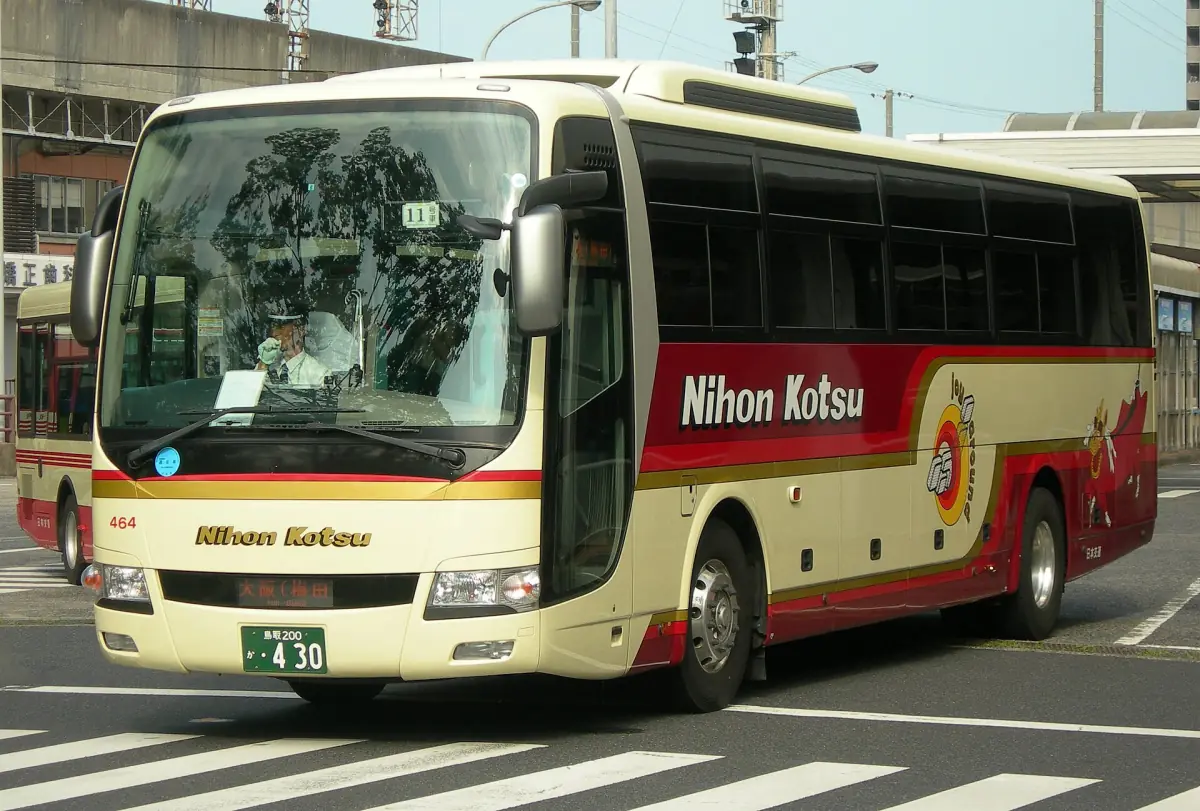
The Nihon Kotsu highway bus connects Osaka and Kobe with Tottori, Kurayoshi and Yonago, and also runs to Hiroshima. An adult ticket from Osaka Umeda, OCAT or Bentencho to Tottori Station costs 4,200 JPY, and children pay half. Travel time depends on the departure, and it differs between the Osaka stops, so check the timetable for the bus you plan to take. The timetable was partly revised on 18 July 2026. The Tottori to Kyoto line is currently marked as suspended, so do not count on it.
The bus suits travellers who are not in a hurry and want the lower fare. The train suits anyone who wants a predictable arrival time and a seat reserved in advance.
Rail passes and local bus passes
The San'in-Okayama Area Pass stopped being sold on 15 March 2024, so it is not an option for 2026. Links to it may still appear in older JR terms, but they are no purchase option. The Kansai-San'in Area Pass is still shown on the JR West website. It lists seven consecutive days at 18,000 JPY for adults aged 12 and over and 9,000 JPY for children aged 6 to 11, for visitors with a foreign passport and Temporary Visitor status. The page carries an information date of 1 August 2024, so confirm the current price and rules before you rely on it. The pass covers the Sanyo Shinkansen between Shin-Osaka and Okayama and listed JR West trains, but not the Tokaido Shinkansen and not highway buses.
For local buses there are two options. The Tottori-han Norihodai Tegata costs 1,800 JPY for three days and covers listed prefectural buses and some town buses, but not JR trains or highway buses. In the middle of the prefecture, the Yu-Yu 2-day pass costs 1,300 JPY and covers listed lines around Kurayoshi, Misasa, Mitoku, Hawai and Togo. It is not a nationwide rail pass.
Taxi and transfer from Yonago Kitaro Airport (YGJ)
Airport buses are the main public link at both airports.
From Yonago Kitaro Airport an airport bus runs to JR Yonago Station. It costs 640 JPY and takes about 25 minutes. A separate regular line bus costs 600 JPY. Another airport bus runs to Matsue and costs 1,200 JPY for a ride of about 45 minutes. If a flight is cancelled, the connected bus may be cancelled too, so check on the day.
Ask the driver or the taxi counter for the fare before you set off, particularly if your hotel is in Kaike or near the foot of Mount Daisen.
Tottori Airport (TTJ), officially Tottori Sand Dunes Conan Airport, is the eastern gateway. The airport bus takes about 20 minutes to Tottori Station and about 45 minutes to Kurayoshi Station. A direct bus from the airport to Misasa was discontinued on 31 March 2019, so plan to change at Kurayoshi. The page on Yonago Airport and Tottori Airport has the flight details.
Car hire and parking
A car makes sense if you want to cover Daisen, the coast and the old towns in one trip.
You can pick up a rental car at both airports. At Yonago the counters are on the ground floor of the terminal. Some firms ask you to return the car at the airport, others at a nearby office. There is also a rental station at Kurayoshi Station, where a reservation in advance is recommended. Prices, availability and parking fees vary by company and place, so ask when you book and when you check in at your accommodation.
You need an international driving permit under the 1949 Geneva Convention. A permit under another convention is not enough. Licences from some countries, including Germany, Switzerland and France, are accepted together with a Japanese translation issued by an approved body. A translation you have made yourself or had certified abroad is not accepted. In general the permission runs for up to one year from entry and only while the document is valid.
On the road, the Tottori Expressway between Sayo JCT and Tottori IC is toll-free. This does not apply to other expressways. National Route 313 is closed all day to the north of Kurayoshi, on a stretch of roughly 1.7 km between Hokuei IC and the junction with National Route 9, until the Hojo road opens. Check the current situation before you drive there.
Find a rental car at Car rental at Yonago Airport (YGJ) on Economybookings.
Getting to Tottori: frequently asked questions
How long does it take to get from Osaka to Tottori?
The Super Hakuto takes about 2 hours 30 minutes from Osaka to Tottori and about 3 hours to Kurayoshi. Seats are reserved, and the adult fare to Tottori is 7,520 JPY. The highway bus costs 4,200 JPY.
Can I get from Okayama to Tottori by train?
Yes. The Super Inaba runs from Okayama to Tottori in about 1 hour 50 minutes, at 5,400 JPY for adults at the normal-season rate. The Yakumo line goes to Yonago and Matsue instead, not to Tottori city.
Is the San'in-Okayama Area Pass still on sale?
No. Sales ended on 15 March 2024. The Kansai-San'in Area Pass is a separate product, listed with a seven-day validity at 18,000 JPY for adults on a page dated 1 August 2024, so confirm the current terms.
Which airport should I use for Tottori?
Tottori Airport (TTJ) is closest to Tottori city and has flights from Tokyo Haneda. Yonago Kitaro Airport (YGJ) is better for Daisen, Kaike and Sakaiminato. Both are small, so check the day's schedule before you book.
What do I need to rent a car in Tottori?
An international driving permit under the 1949 Geneva Convention, or a licence from an accepted country together with an approved Japanese translation. Rental counters are at both airports and at Kurayoshi Station.