
Tottori Castle and Hideyoshi's siege
Tottori Castle was built in the Sengoku period, the age of warring lords. It is remembered for the siege led by Toyotomi Hideyoshi, who starved the castle by cutting off its supplies instead of storming it. That story is the first thing most visitors hear about the city's past, and it explains why the walls on the hill matter.
Today the castle is mostly stone walls and foundations, with a reconstructed gate and bridge. Do not expect a complete castle. From Hisamatsu Park it is about 10 minutes on foot to the Ninomaru and about 40 minutes to the top of the hill. The place to start a walk is the Tottori City page.
Our pick: a night walk through yokai folklore
A 90-minute walk down Mizuki Shigeru Road after dark with folklore about the yokai. It is a folklore walk, not a history lecture.
Hand-picked tours, booked through GetYourGuide. Prices are indicative starting prices in US dollars (as of October 2026). Tap a tour for live availability and the current price in your currency.
Folklore and history on foot
Guided walks and tours that bring the stories of the region to life.
Daisen-ji and Ogamiyama
A temple and a shrine that grew side by side.
On the slope of Mount Daisen, the temple of Daisen-ji and the shrine of Ogamiyama developed within the older Japanese blend of Buddhist and Shinto worship. In the early Meiji period, when the government separated the two religions, the temple and the shrine were separated as institutions too. The founding year of the shrine is unclear in the local account. Practical details for a visit are on the Mount Daisen page.
Amida-do
A hall with a destruction date and a rebuilding date.
The Amida-do at Daisen-ji is described by the local monument page as destroyed in 1529 and rebuilt on its present site in 1552. That is the dating handed down locally, and it is best read as tradition, not as a surveyed record. The interior is open only on certain days, which are listed on the Mount Daisen page.
Kurayoshi castle town
White walls, red tiles and a canal.
Kurayoshi began as a castle town near Mount Utsubuki in the Muromachi period. In the Edo period it grew around the administrative residence, and many of the trading houses and storehouses along the Tamagawa canal come from the Edo and Meiji periods. Not every facade dates from the same time, so do not assume that every white wall is of one age. The town's old streets are on the Kurayoshi page.
Nijisseiki pears since 1904
The fruit that became a symbol of the prefecture.
The Nijisseiki pear came to Tottori in 1904, when Eiji Kitawaki brought 10 saplings from Chiba. According to the prefecture, the main season for pears grown outdoors runs from late August to mid-September. The pear has since become one of the best known local products, and you can read about it together with crab and ramen on the Tottori food page.
Yokai folklore and Mizuki Shigeru
Spirits, shadows and the port town that tells their stories.
In Sakaiminato, the port town, yokai are part of everyday life. Bronze figures line the road named after the artist Mizuki Shigeru, and the Mizuki Shigeru Museum has operated again in its renewed form since April 2024. An evening guided walk along the road tells stories of Japanese spirits and folklore, includes a stop at the Yokai Shrine and offers photo spots with yokai statues and shadow projections. It runs for about 1.5 hours and starts at Sakaiminato Station. More on the road and the museum is on the Sakaiminato page.
The San'in Kaigan Geopark
Older than any castle.
The San'in Kaigan area, which includes the coast, was recognised as a Global Geopark in October 2010. The geopark covers the geology of the opening of the Sea of Japan together with the culture and history of the coastal communities. The sand dunes and the Uradome coast have their own guide at Tottori Sand Dunes, and the things to do page links to the rest of the prefecture.
Jinpukaku today
A white mansion that is closed for conservation work.
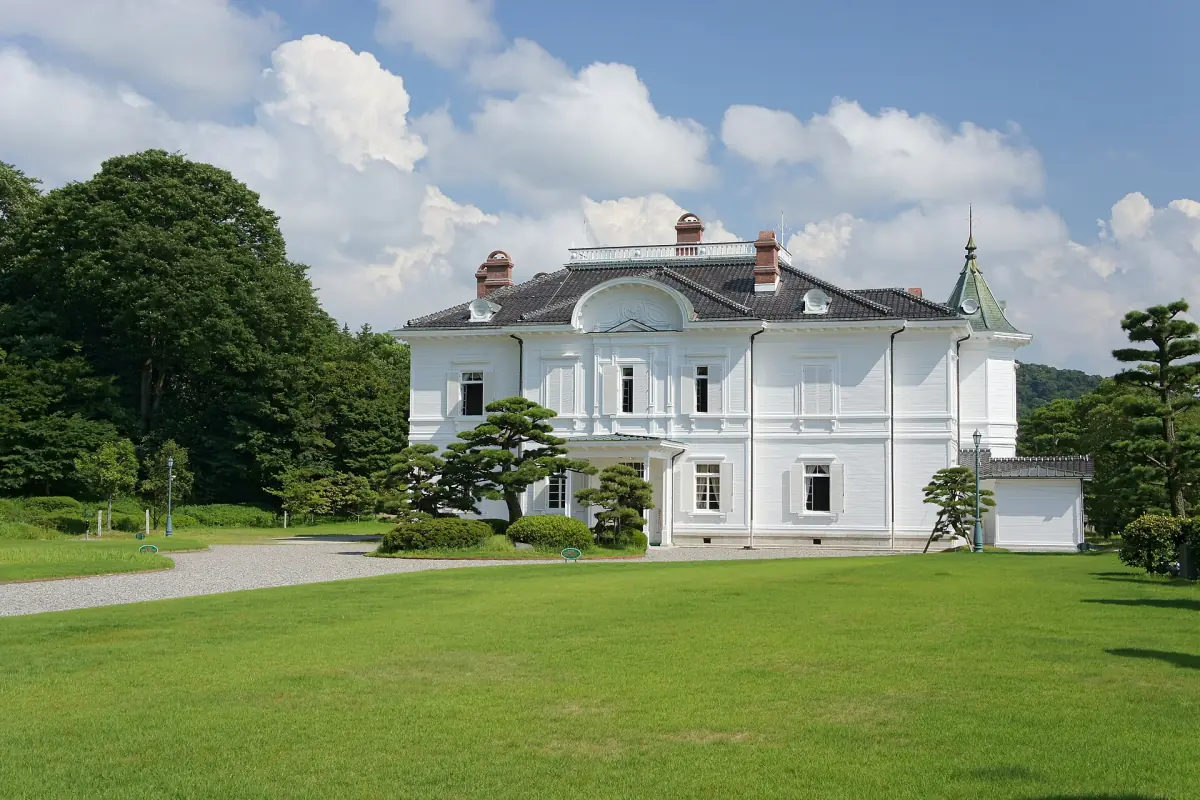
The photo above shows the Jinpukaku, a white Western-style mansion in Tottori City. It has been closed since 29 December 2023 for conservation work, and since the end of September 2025 the building has been covered by the construction site. No reopening date has been announced, so do not plan a visit to the interior. The Ho-ryu-in garden and Ho-sen-an remain accessible.
Tottori history: frequently asked questions
What is Tottori Castle known for?
It was built in the Sengoku period and is known for Hideyoshi's siege, in which supplies were cut off. Today you see stone walls, foundations and a reconstructed gate.
When was the Amida-do rebuilt?
The local monument page gives 1529 for its destruction and 1552 for the rebuilding. This is the dating passed down locally.
When did the Nijisseiki pear come to Tottori?
In 1904, when Eiji Kitawaki brought 10 saplings from Chiba, according to the prefecture.
Can I visit the Jinpukaku?
It has been closed since 29 December 2023 and is covered by a construction site. No reopening date has been announced.
When did the Mizuki Shigeru Museum reopen?
The city confirms renewed operation since April 2024.